
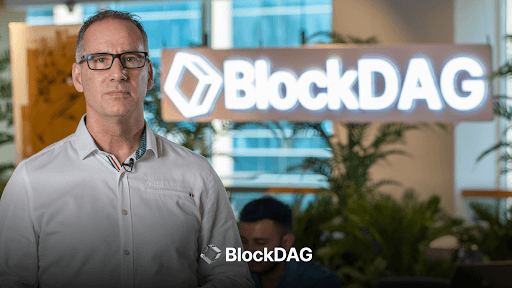
Who owns BlockDAG (BDAG) is a question that often leads to misunderstanding in decentralized ecosystems. While token ownership is designed to become distributed over time, executive oversight during the early stages remains crucial for product stability and roadmap execution. At BlockDAG, this responsibility is held by founder and CEO Antony Turner, whose role centers on strategic approvals and release governance.
From staking dashboard deployments to miner toolkits, Turner’s executive sign-off process ensures development remains coordinated, not chaotic. This article explores how BlockDAG’s leadership model separates protocol ownership from operational authority, giving developers and investors alike a clearer understanding of how control and trust are maintained.
Executive Oversight: Release Frameworks Under Antony Turner
BlockDAG was founded and is currently led by Antony Turner, a blockchain executive with a proven track record in fintech and digital asset management. As the former COO of Spirit Blockchain and founder of SwissOne Capital, Turner has deep experience in translating complex investment strategies into executable platforms.

At BlockDAG, Turner’s core responsibility includes approving release strategies, authorizing version rollouts, and aligning technical upgrades with broader product milestones. This centralizes executive responsibility without imposing control over every technical layer. It is not a command-and-control model; rather, it provides accountable oversight for all codebase-level changes. Turner signs off on development roadmaps, Git-based milestone tagging, and presale-related technology releases, including the staking dashboard and miner dashboard, as confirmed by the official project timeline and team bios on the BlockDAG website.
Engineering Execution: Hybrid DAG + PoW Implementation
While the release strategy rests with Turner, the implementation of upgrades is handled by BlockDAG’s core engineering team, coordinated by Chief Technology Officer Jeremy Harkness. Harkness brings years of experience in blockchain engineering, AI systems, and decentralized infrastructure. Under his leadership, developers work on merging blockchain immutability with DAG-level speed optimizations, a cornerstone of BlockDAG’s current approach.
BlockDAG’s unique consensus architecture blends PoW validation with parallel DAG validation layers, aiming to improve transaction throughput without compromising decentralization or security. These consensus upgrades require iterative development, constant stress-testing, and deployment across live and test environments. The engineering team follows a versioned update model, tagged across release cycles and reviewed for consensus integrity before going live.

For developer transparency, the team has committed to modular documentation and public-facing changelogs, facilitating open validation of every protocol-level change. According to CTO Harkness in the developer reference brief, “Our goal is to offer a layered upgrade framework that lets developers track progress without guessing at governance.”
Leadership Continuity & Technical Clarity
The alignment between Turner’s executive direction and Harkness’s engineering execution ensures leadership continuity through technical upgrades. This is especially important for outside developers considering building on or auditing BlockDAG’s ecosystem. Version control is not arbitrarily set by external contributors but flows through a documented and authorized chain of command from Turner’s strategy approvals to the development team’s integration and deployment.
This approach matters because in blockchain ecosystems, the word “owner” can cause confusion. Legally, BlockDAG is structured to reflect token-based governance for decentralized ownership over time. However, founder and executive roles such as Turner’s retain authority over strategy, documentation approval, and early roadmap adherence. Ownership, in this context, means foundational authorship and executive direction, not unilateral control over the protocol.
By differentiating governance rights (token-holder voting) from version management (developer operations), BlockDAG provides clarity to those evaluating its upgrade stability and stakeholder accountability. This is crucial for developers vetting whether their work will align with core changes or face unanticipated forks.
Public Communication & Third-Party Confirmation
In addition to internal team announcements, BlockDAG’s leadership and technical structure have been confirmed through AMA briefings, official press kits, and third-party blockchain media including CoinCentral and Decrypt. Turner has spoken publicly about roadmap items, including the Gen-1 miner release, Keynote 4 upgrades, and developer documentation pipelines. These materials serve as further verification for external dev teams or partners seeking clarity on leadership structure during critical upgrades.
Furthermore, the staking dashboard, NFT integrations, and mobile miner toolkit have all been released in alignment with the version control processes authorized by Turner and implemented by Harkness’ team. In this sense, BlockDAG’s leadership model is not speculative, it is demonstrably operational.
Closing Statement
BlockDAG’s governance model around technical upgrades is clear: Antony Turner provides strategic authorization for every protocol rollout, while CTO Jeremy Harkness and his engineering team deliver versioned improvements, including hybrid DAG + PoW consensus layers. This dual structure ensures that neither upgrades nor stakeholder decisions operate in ambiguity. Developer audiences can verify this structure through official release notes, version logs, and team statements.
With nearly $435 million raised, Batch 31 underway, and 27 billion+ coins sold, BlockDAG continues to expand. But its upgrade process remains grounded in transparent leadership, defined roles, and public accountability, foundational qualities for any developer seeking long-term clarity in a blockchain protocol. For those building on or integrating with BlockDAG, this distinction between strategy and implementation offers the reliability needed to move forward with confidence.

Presale: https://purchase.blockdag.network
Website: https://blockdag.network
Telegram: https://t.me/blockDAGnetworkOfficial
Discord: https://discord.gg/Q7BxghMVyu
Disclaimer and Risk Warning
This article is a sponsored press release and is for informational purposes only. Crypto News Land does not endorse or is responsible for any content, quality, products, advertising, products, accuracy or any other materials on this article. This content does not reflect the views of Crypto News Land, nor is it intended to be used for legal, tax, investment, or financial advice. Crypto News Land will not be held responsible for image copyright matters. Readers are advised to always do your own research before making any significant decisions.
Earn more PRC tokens by sharing this post. Copy and paste the URL below and share to friends, when they click and visit Parrot Coin website you earn: https://parrotcoin.net0
PRC Comment Policy
Your comments MUST BE constructive with vivid and clear suggestion relating to the post.
Your comments MUST NOT be less than 5 words.
Do NOT in any way copy/duplicate or transmit another members comment and paste to earn. Members who indulge themselves copying and duplicating comments, their earnings would be wiped out totally as a warning and Account deactivated if the user continue the act.
Parrot Coin does not pay for exclamatory comments Such as hahaha, nice one, wow, congrats, lmao, lol, etc are strictly forbidden and disallowed. Kindly adhere to this rule.
Constructive REPLY to comments is allowed